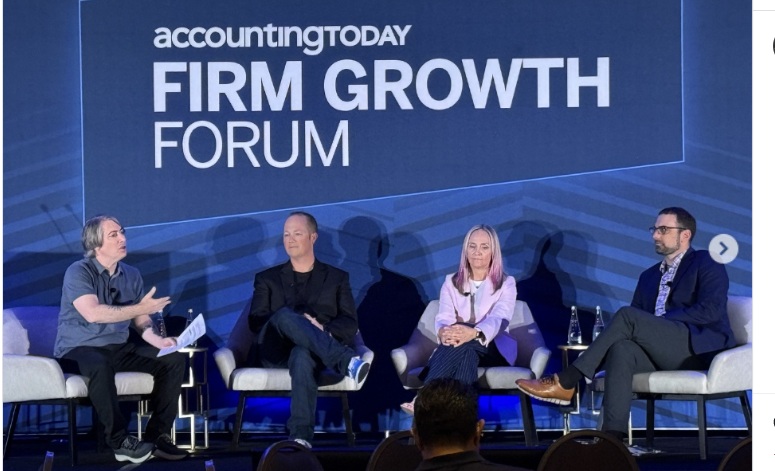
I recently wrote about how subjective growth has become for CPAs and accounting firms in general. I’m now digging into what came out of conversations, sessions, and overall feedback from an industry event focused on all of the things impacting the topic: Firm Growth Forum.
Whenever you are at a live event, you realize that while you don’t get a full picture of professional opinions, you do manage to see a subset of it. And when firm leadership is present, it’s even more pointed. So, what follows here is from my observations in that environment.
On Growth: Yes, it’s the topic of the day. And as I’ve indicated in the past, growth means different things to different people in this profession. One thing that is consistent: when seeing direction on growth, it needs to come from a place of trust and some level of authority.
In the end, there’s no real “wrong” way to grow, but it needs to be consistent with your own vision and a plan that will get you there. Even if that plan evolves every few years, because let’s face it, the days of the 10-year plan are essentially done, given the pace of change in the profession and business in general. But I digress; we’re here to talk about the forms of growth.
If growth is coming in the form of revenue (say, moving from $5 million to $25 million over X amount of time), then you want to hear from folks who’ve done it and how. There are numerous ways firm leaders at FGF mentioned they did, or are doing, that. But as indicated above, the one consistent thread was having a clear vision on the kind of firm they wanted to be and how to get there.
Certainly, private equity plays a role in the path to such growth. And while the majority of firms have either been approached by PE or will be in relatively short order, again the clear vision for where you want your firm to be comes into focus.
Private equity and even M&A (another growth path) discussions were not as prevalent compared to last year, quite possibly because a good segment of firms present at FGF fall into the aforementioned group of either having taken PE already or having been approached and are evaluating or choosing to remain staunchly independent.
Growth through new service areas remains popular, growing advisory-level services ranging from tax to tech to wealth management or niche-related guidance. With these again, sometimes PE makes sense, sometimes not, and speaking with other firm leaders will often give you support in your own decisions.
On AI: As strong as the PE discussions were last year (and still remain this year), AI took more of the spotlight at this year’s event. If we’re looking at a timeline, we’re about three years in to an AI boom that has only barely scratched the surface of potential. This in and of itself is causing both excitement and concern.
Firms are excited at the prospect of the transactional nature of work being reduced, opening the door to have time for more impactful conversations and engagements with clients. They’re also concerned about the unknown, particularly from a security and, in some cases, staffing point of view.
The hope is that more accountants will learn to work with tools and platforms available to them and see even in their own hands how tasks will no longer define accounting, but outcomes will. And as more practitioners and firm leadership lean into what’s possible, progress with AI can (and should) surpass the pace that cloud technology did.
The main difference between what accountants experienced with the cloud and what they are currently experiencing with AI has to do with control. With the cloud, no one really knew where data went; they only knew it was not in their hands and the technology behind it was not built by them.
And if any changes had to be made or inconsistencies spotted with what platforms could and could not do, unless you understood APIs or coding on your own, you had to wait for an upgrade or some other tool that did solve your problem. With AI, by and large, the power to solve for any of those issues is in the user’s hands, and this is what excites practitioners the most.
On Diversity: Too much has been politicized and created confusion around the issue of diversity in the profession. But from where I sit, and have sat for decades, I can say that true growth in accounting is only going to come if a commitment to diversity is a part of it.
The accounting profession, like our own culture, has come far…but not far enough. We cannot stop here. We cannot look around at the faces of the profession and say it’s enough. And, again, though industry conferences don’t give a full picture, the snapshot does speak volumes.
I know from an inside/planning point of view efforts are indeed made to reflect how the profession is evolving. But its true face still needs improvement, and while it’s on event organizers to showcase balance, when the profession as a whole still is not in many areas (leadership most glaringly), then to me, diversity’s call needs to be answered.
Not, of course, for the sake of being diverse, but to truly reflect the world we live in and to do better to show it. And from a talent perspective, people want to be a part of a firm that makes efforts to reflect that world and a part of the change that is so sorely needed.
On What’s Next: No one has a real crystal ball. We can only deal with the Now. But with the Next coming on faster than at any time in known history, understanding what’s possible with what’s available now — be it growth methods and strategies or technology — will put accountants in a better position for what’s coming.