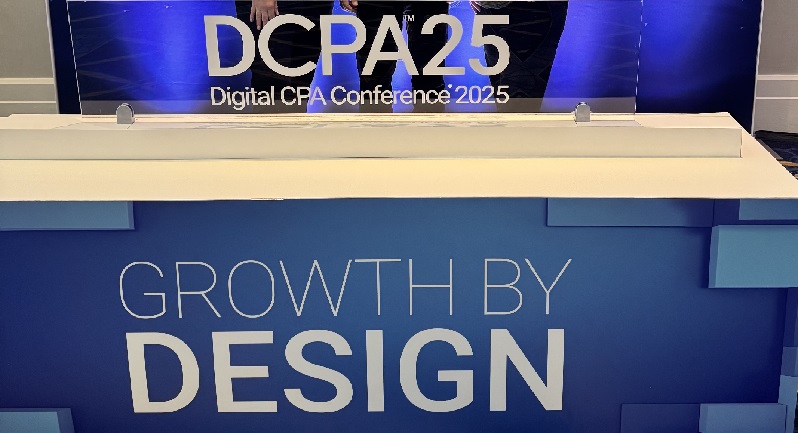
Accounting firm growth can come in many forms, but if it is without purpose or specific planning, it may as well not happen at all. This was not only one of the main themes of the recent Digital CPA (DCPA) conference but also a wake-up call to anyone making decisions for their firms now and in the foreseeable future.
Given all that I have gleaned from DCPA and my myriad conversations and learnings throughout this year, my statement above was not to imply that firm decisions are made in a bubble or with little thought to planning. Rather, given the state of the profession and business in general, it has become more imperative that firm leaders look at what growth means to them, put the work in to plan for it, and above all, be intentional.
Moreover, too many factors are making it increasingly difficult to just stay as you are. This is not a veiled threat or more “change or die,” but rather there is more opportunity to actually be the kind of firm, business, and profession that you want; it behooves leaders to truly take the reins, plan, and delegate. As for those working in a firm, you too have a voice in how you work and the kind of career you actually want. All of this, again, starts with intention.
Allow me to elucidate (yes, big word) on what I’m on about. First off, you’d have to be under a proverbial rock in accounting to not know the main, outside factors impacting the profession are AI and Private Equity. Both are, in their own way and together, forcing a narrative not only of change but also of opportunity, at what I see as one of the sharpest points of inflection that this profession currently resides in.
But like all other points of inflection that accounting has experienced, whether it was the move from paper to desktop software, the impact of the Sarbanes-Oxley Act; the coming (and staying) of The Cloud; firm leaders and accountants as a whole have either pushed back or embraced the changes these events brought. Now, between the aforementioned, the last throws of the “aging out” of firm leaders, and accounting needing a better story to tell for new talent to want to join and stay in this profession, it could not be a better time to find out, and execute on, what kind of firm and accounting professional you want to be.
So, this is the main point I wanted to make. And, make no mistake about it, I will indeed be following how both AI and PE, among other factors, ultimately influence accounting decisions and growth. To add even more perspective, I compiled a list of soundbites I thought were pointed and telling not only about the direction DCPA seems to be taking (no longer just about their own agenda), but also the aforementioned market factors therein:
On Growth
“We used to talk about training, planning, and upskilling for the next 5-7 years; it’s now the next 5-7 months.” – Mark Koziel, AICPA President.
“DCPA is no longer a CAS conference. It is about designing growth as a system. Growth is no longer one team’s job.” -Erik Asgeirsson, CPA.com President.
“Accountants need to [take the time to] get their value proposition right. We are at the inflection point today to lean in and do that.” Irfan Dossani, Partner in charge of advisory, Whitley Penn.
On AI in Accounting
“Because AI is out there, it doesn’t mean you have to figure out how to implement all of it. A lot of it is, or will be, in tools you already use.” -Koziel.
“We believe gen AI is perfectly suited for tax research and tax prep, ultimately helping practitioners with tax planning and advisory.” –Asgeirsson.
“AI needs to help us build a more affordable and comfortable future. It can if we truly want it to. Most accountants [and people] are afraid of what it looks like to have that time and space where they aren’t working as much.” –Zack Kass, Futurist, former head of GTM, OpenAI.
“AI is going to give accounting back to accountants. Getting rid of controllership, mundane tasks will not be on you anymore.” -Rene Lacerte, founder & CEO, BILL.
“Have a strategy for how you want to deploy AI over time. Don’t take on more tech debt than you need to.” -Lacerte.
Closure
It’s been an interesting few years, to say the least, from where I sit. All I can provide is perspective; you all are living it every day and the decisions you are making, or considering, today can have short or longer-term effects. We simply don’t know, and that’s OK.
What you can control is having a vision for where you want your business to be and the kind of accounting professional your clients will want at their side for years to come. Start with intention, and know any changes or plans you have can and will come to fruition. All the best to you in the New Year and beyond.